
A person sits in a chair without a backrest, spine unsupported, forearms resting on the thighs, head drooping slightly forward, eyes closed. Nothing about the posture asks for effort. The instruction that follows asks for even less: repeat a short phrase silently, several times, and do nothing to make it come true. “My right arm is heavy.” Not tensing the arm, not willing it to feel heavy, not checking whether it has worked — simply holding the sentence in mind and letting attention rest there. This is autogenic training, a self-relaxation method based on autosuggestion and built entirely around six such phrases, developed by the German psychiatrist Johannes Heinrich Schultz and later set out at length together with his student Wolfgang Luthe.
Passive concentration, not relaxation on command
What separates autogenic training from an instruction to “relax” is the principle at its centre, passive concentration — described in the literature on the method as “complete, effortless mental immersion in the task.” In hypnosis performed by an outside operator, someone else induces the state. In most relaxation coaching, a person is told to actively loosen a muscle or slow a breath — an act of will aimed at a result. Autogenic training asks for neither. The practitioner attends to a simple verbal formula and to whatever sensation arises on its own, without straining toward the sensation and without judging whether it has appeared strongly enough. That distinction is the mechanism of the whole method: the changes that follow — genuine heaviness, genuine warmth — are described as self-generated, which is what the word “autogenic” is built to say, rather than induced by anyone or anything outside the practitioner.
The method is practiced in one of three positions: seated in an armchair with the head, back and arms supported; seated on a stool or hard chair in the slouched, forward-leaning posture sometimes called the coachman’s position; or lying on the back with the arms loose at the sides and the legs slightly apart. Each removes the need for muscular effort to stay upright, so that nothing competes with the passive attention the exercises require.
The six exercises
Schultz and Luthe arranged the method as six standard exercises, practiced in sequence and, in most courses, added one at a time so that each is well established before the next is introduced.
The first targets heaviness in the limbs. The formula — “my right arm is heavy,” moving in later repetitions to the left arm, then the legs — is repeated silently while attention simply follows the arm or leg named, without trying to make it feel any particular way. Heaviness, in the method’s own account, is what unclenched muscle feels like once nothing is fighting gravity.
The second targets warmth in the same limbs, using the same rotation of phrases with “warm” in place of “heavy.” Where the first exercise attends to the weight of a limb, the second attends only to its temperature — the sensation of a hand that has stopped being held tense, attended to in the same passive way and with no attempt to bring it on.
The third turns to the heartbeat: “my heartbeat is calm and regular,” attended to rather than counted or monitored. The fourth does the same for breathing — “my breathing is calm and regular” — again without any attempt to slow or deepen it deliberately; the phrase is aimed at breath as it already is, not breath as a target to reach.
The fifth exercise moves into the abdomen: “my abdomen is warm,” directing attention to the upper abdomen, the region around the solar plexus. The sixth and last reverses the temperature direction entirely: “my forehead is cool,” an agreeable coolness across the brow, set deliberately against the warmth the practitioner has spent the previous two exercises attending to.
Each exercise typically closes with a short return formula — arms tensed, a deep breath taken, eyes opened — restoring ordinary alertness before the practitioner stands up or resumes other activity. Schultz and Luthe’s own account treats the sequence as cumulative: a practitioner who has spent weeks internalizing heaviness and warmth moves through the later exercises with a state already partly established, rather than starting fresh each time.
From a Leipzig monograph to six volumes
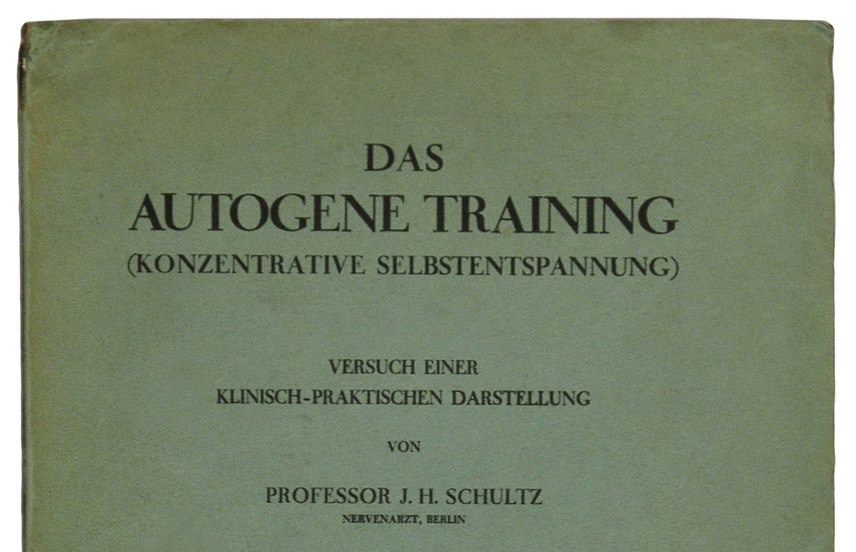
The method reached print in 1932, in a German book Schultz published alone: Das Autogene Training (Konzentrative Selbstentspannung), subtitled an attempt at a clinical-practical account, three hundred and five pages, issued in Leipzig by Georg Thieme. The cover gives his name as professor and nerve specialist in Berlin, with no co-author beside it.
The English-language version came much later and ran much longer. Autogenic Therapy filled six volumes in 1969, credited jointly to Schultz and to Luthe, his student, the first of them — Autogenic Methods — given over to the exercises themselves.
The verdict of one large review
Autogenic training has since been the subject of decades of clinical trials across a long list of conditions — tension headache and migraine, hypertension, asthma, anxiety disorders, sleep disorders, preparation for childbirth. A 2002 meta-analysis gathered seventy-three of those outcome studies and pooled sixty of them. Against untreated control groups it reported “medium to high effects on the main clinical outcomes,” and that pattern held when patients were assessed again at follow-up. Against other established psychological treatments for the same conditions, the same review placed autogenic training as similar or less effective.
Still taught, still daily
Autogenic training is still in clinical use, and still practised well outside the clinic — in education, industry, sport. It is taught individually or in a group, the exercises learned progressively rather than picked up from a single instruction sheet; a session takes only about fifteen to twenty-two minutes, and is meant to be done daily. The sequence remains the one Schultz set out: heaviness, warmth, heartbeat, breath, abdominal warmth, forehead coolness.