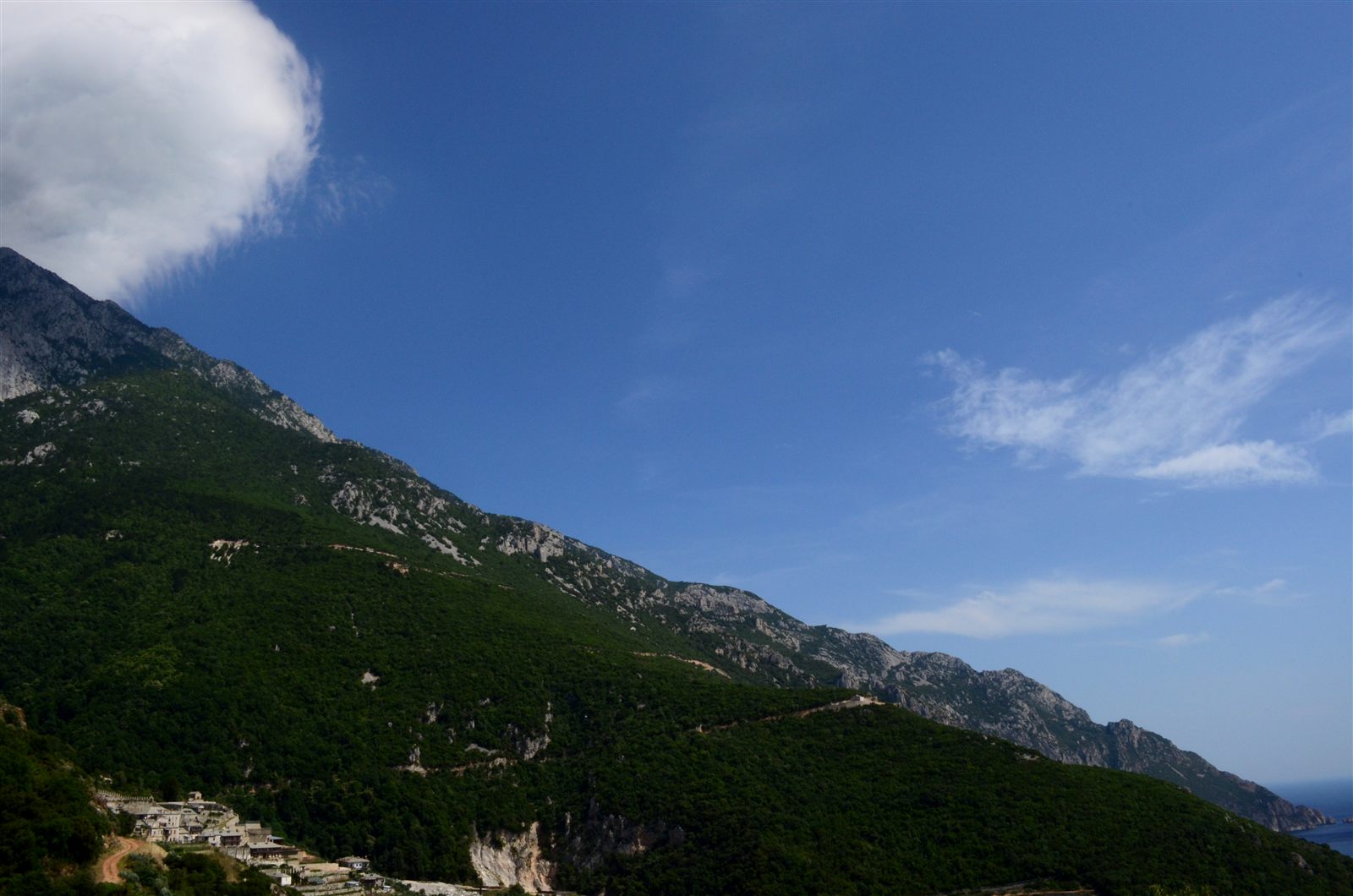
On the wooded peninsula of Mount Athos, the hesychast instruction texts describe a monk settling onto a low stool, letting his chin sink toward his chest, eyes trained downward and inward toward his own body. The texts do not all agree even on this much — Ware notes that in Orthodox practice no particular posture is essential, the prayer being said seated, standing, kneeling, or, in cases of bodily weakness and exhaustion, lying down — but the more exacting ones are specific: breath slowed, and on that breath a single sentence repeated for hours: Lord Jesus Christ, Son of God, have mercy on me.
This was the method Byzantine monks called the Jesus Prayer, and the discipline built around it — synchronizing the words with breath and body — became known as hesychasm, from hesychia, a Greek word for stillness or quiet. The prayer and the pursuit of inner stillness reach back centuries earlier, to the desert fathers and writers like the seventh-century Isaac the Syrian; what took shape on Mount Athos in the thirteenth and fourteenth centuries was a specific, detailed physical method, and, from the late 1330s, one of Byzantine Christianity’s sharpest theological disputes over whether that method was legitimate at all.
The prayer itself
Bishop Kallistos Ware’s The Power of the Name is a widely cited modern account of the practice; it gives the core formula as “Lord Jesus Christ, Son of God, have mercy on me,” though monks varied it, sometimes shortening it to “Lord Jesus” or adding “a sinner” at the end. What stayed constant was the name itself, repeated until, in the tradition’s language, it moved from something the monk said to something that seemed to happen on its own — a shift some hesychast writers called self-acting prayer.
Orthodox teaching held that the prayer moved across three levels — but Ware is careful to stress these are “interpenetrating levels rather than successive stages,” not rungs a monk climbed once and left behind. Prayer of the lips was spoken aloud, or at least mouthed. Prayer of the nous — the mind or intellect — was held silently, word by word, in attention alone. Prayer of the heart, the deepest and rarest, was said to involve the intellect descending into and uniting with the heart, so that the words continued of their own accord rather than being constructed sentence by sentence. Even this was never treated as guaranteed: citing the seventh-century writer Isaac the Syrian, Ware notes that “scarcely one in ten thousand” was counted worthy of the gift of pure prayer — a gift, in the tradition’s own framing, not an achievement technique alone could deliver.
The mechanics: posture, breath, and rhythm
It was the physical instructions accompanying the prayer that made hesychasm distinctive — and, eventually, controversial. Ware gives two reasons the body was involved at all: a psychophysical one, that a change in physical condition affects psychic activity in turn, and an incarnational one, that if Christ took on flesh, the flesh should have some part in addressing him. The written record of the technique begins later than the practice itself. The earliest detailed account in Greek belongs to the closing years of the thirteenth century — On Vigilance and the Guarding of the Heart, whose author, Nicephorus the Hesychast, was an Athonite monk; he used the same standard wording, “Lord Jesus Christ, Son of God, have mercy on me.” How widely it was read at the time is doubtful. Gregory of Sinai reached Athos in the opening years of the fourteenth century, less than a generation after Nicephorus’s death, and had to hunt at length before turning up anyone with practical experience of hesychia and inner prayer; his own grounding in it came from Crete, acquired before he ever set foot on the Holy Mountain. Gregory gave specific guidance on posture: sit on a low stool, Ware records him advising, “about nine inches high,” head and shoulders bowed, gaze turned down toward where the heart was understood to sit inside the chest. A stricter variant, attributed to some hesychast writers, folded the body further: head lowered between the knees, echoing the stance the tradition assigned to the prophet Elijah on Mount Carmel.
Breath was the second element, synchronized deliberately with the words. The common pattern split the prayer across the breath cycle: the first half — “Lord Jesus Christ, Son of God” — spoken or thought while inhaling, the second half — “have mercy on me a sinner” — released on the exhale. Ware notes that other methods were possible too, the words sometimes matched instead to the beat of the practitioner’s own pulse.
A third aid was physical rather than respiratory: a knotted wool cord called a komvoschoinion, typically tied in a hundred knots and passed through the fingers as the prayer continued. Its main purpose, Ware notes, was not counting repetitions but keeping a steady rhythm — “an aid to concentration and the establishment of a regular rhythm,” as he puts it.
A further layer aimed the exercise at a specific point in the body. “The Three Methods of Prayer,” a text attributed in the Philokalia to Symeon the New Theologian but generally regarded by modern scholarship as the work of a later, anonymous hesychast writer, instructs the practitioner to slow the breath and, in its own words, to “search inside yourself with your intellect” until the heart itself could be located. Ware describes the same general method in similar terms: the practitioner inhales, and, as he “propels his breath down into his lungs,” the intellect is made to descend along with it. The same text goes further on posture than Gregory of Sinai did, instructing the monk to rest his beard on his chest and direct his gaze toward his own navel rather than the wider region of the heart — a difference in emphasis the hesychast texts themselves did not fully resolve.
Two further details, drawn from later Orthodox sources, round out the picture. The nineteenth-century Way of a Pilgrim describes a specific escalating count — 3,000 repetitions a day, then 6,000, then 12,000 — though Ware calls this kind of quantification “altogether unusual,” and the bishop Theophan the Recluse advised against counting at all. Conditions mattered too: the prayer was normally said in near-darkness or with the eyes closed, and the twentieth-century Athonite monk Silouan is remembered for shutting his clock in a cupboard and pulling a wool cap down over his eyes and ears to remove every distraction.
Without a guide, Ware warns, a beginner searching for the heart’s location risked settling attention just below it instead — into the abdomen rather than the chest — which the tradition held would stir up “carnal thoughts and sensations” rather than stillness.
A method that came with warnings
None of the hesychast writers who described this technique presented it as safe to attempt casually — though none presented it as reliably dangerous either. Ware is blunt about the risk in the abstract: “Misuse of the physical technique can damage someone’s health and disturb his mental equilibrium.” But he immediately qualifies it: where no starets is available, the safest course for a beginner is to say the prayer and nothing more, leaving breath-rhythm and heartbeat entirely alone. In most cases, Ware observes, the breathing falls into step with the words of its own accord, without any deliberate effort; and should that not happen, “there is no cause for alarm” — the mental invocation is simply carried on as before.
The nineteenth-century Russian bishop Ignatii Brianchaninov struck a similarly cautious note, writing that some who tried to learn the technique by experience alone “have damaged their lungs and gained nothing.” Ware cites him chiefly as representative of later Orthodox teachers who, as a rule, laid little emphasis on the physical instructions at all — recommending instead, in Brianchaninov’s own words, simply “gentle and unhurried breathing” alongside the prayer.
Gregory of Sinai himself did not pretend the practice was comfortable: “Your shoulders will ache and you will often feel pain in your head,” he warns — but follows immediately by urging the practitioner to “persevere persistently and with ardent longing,” seeking the Lord in the heart rather than giving up. The requirement of a starets recurs throughout the literature for the same reason the cautions do: followed without supervision, the physical instructions were held capable of doing real harm, not simply of failing to help.
“Navel-souls”: the accusation that gave the hesychasts their nickname
The hesychast tradition was challenged head-on during the decade 1337–47, in what became known as the hesychast controversy. The attack was launched by Barlaam the Calabrian (c. 1290–1348), a learned Greek from southern Italy, who had already clashed with the Athonite monk Gregory Palamas (1296–1359) over whether direct experience of God is possible in this life. To Barlaam the physical instructions were crude materialism and rank superstition, and he coined for their practitioners a Greek nickname that stuck: omphalopsychoi, “those who locate the soul in the navel” — a jab aimed squarely at the instruction to fix the gaze on the belly.
Barlaam’s objections went beyond ridicule. His starting point was that God is incomprehensible; from there he concluded that whatever human beings can know of God while still alive reaches them at second hand — in Ware’s summary of the position, “through Scripture and church tradition, through signs and symbols.” That ruled out the hesychasts’ central claim, an unmediated experience of the divine in this life; and it followed, for Barlaam, that the light some of them reported seeing in prayer could not be the uncreated light of the Godhead at all. It had to be an ordinary created one, registered by ordinary eyes.
Gregory Palamas’s defense
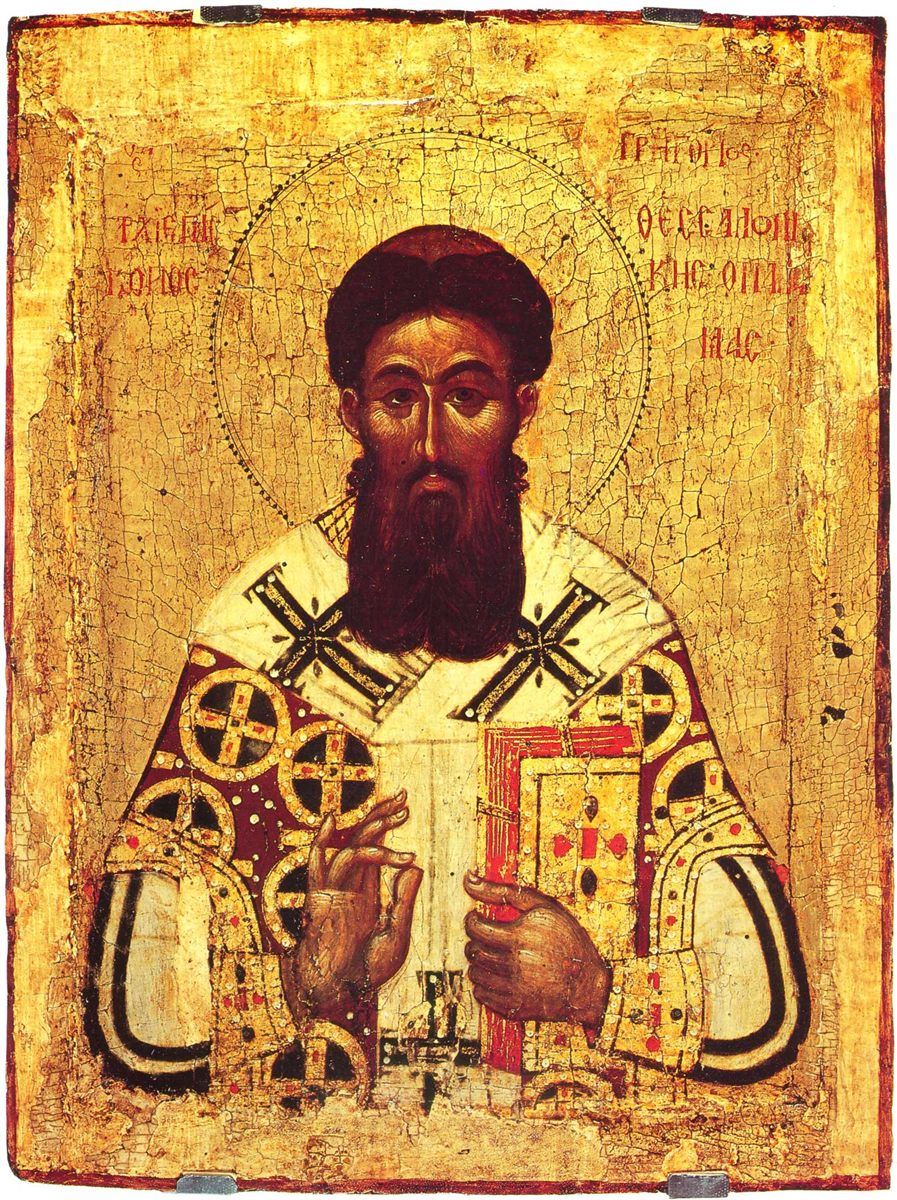
Gregory Palamas, an Athonite monk and later Archbishop of Thessalonica, answered Barlaam directly, most fully in a three-part work known as the Triads. He defended the physical method as theologically permissible but, in Ware’s description, “something secondary and suited mainly for beginners” — not the essence of the practice. His larger argument went further. He distinguished God’s essence, which he held to be radically unknowable — to angels as much as to human beings, in the age to come as much as in this one — from God’s energies, the divine acts of power, which he argued are no intermediary but God himself in action, and open to human participation here and now, body included. The light some hesychasts described witnessing in prayer was, on this account as Ware sets it out, neither a symbol produced by the intellect nor the created light an eye ordinarily registers, but “the divine and uncreated Light of the Godhead” — the light that shone from Christ at his Transfiguration on Mount Tabor. Palamas himself rendered such a vision in the language of overwhelmed sight: writing of the apostle Paul caught up into the third heaven, he places Paul in the middle of a limitless light, “having become nothing but eye.”
The dispute was settled, unevenly, through a sequence of church councils in Constantinople rather than through argument alone. A synod there in 1341 came down on Palamas’s side; Barlaam dropped out of the quarrel and returned to Italy. That did not end it. Akindynos and Nicephorus Gregoras took the anti-hesychast case up again from partly different premises, and the argument dragged on, tangled with imperial politics. Two later councils in Constantinople, in 1347 and 1351, settled it in the Palamite direction. Palamas was appointed Archbishop of Thessalonica in 1347 but did not take up residence until 1350 — a man whose early years had been spent in semi-eremitic solitude ended them in a city, under heavy pastoral duties. He was canonized in 1368, nine years after his death.
What the technique was, and was not
Even its defenders kept the physical method in its place. Palamas himself treated it as an aid, not a requirement: the Jesus Prayer, in Ware’s summary of the tradition’s position, “can be practised in its fullness without any physical methods at all.” Ware draws a specific comparison worth naming directly — the Jesus Prayer, he writes, is not simply Christian Yoga, a form of Transcendental Meditation, or a Christian mantra, even where the postures and breath-work resemble those practices outwardly. What set it apart, in the tradition’s own account, was that it remained an invocation addressed to a specific person; its practitioners understood the words themselves — not the rhythm of breath or the angle of the head — as carrying the technique’s real weight.
The Jesus Prayer did not stay confined to the fourteenth century. Gregory of Sinai left the Holy Mountain around 1335 and stayed out of the Constantinople controversy altogether; it was through his disciples that hesychast teaching travelled north, into Bulgaria, Serbia and Russia. Palamas’s own teaching was upheld at the Council of Blachernae in 1351, and after his glorification in 1368 a commemoration was appointed for the Second Sunday of Great Lent, which the Orthodox Church still keeps each year. The prayer itself remained in continuous use well into the twentieth century — the Athonite monk Silouan, who died in 1938, is one of its better-documented modern practitioners. What survives from the medieval hesychast texts is a strikingly precise physical record: exact instructions for how a body was arranged, how breath was paced against a short repeated sentence, and how attention was directed inward — refined, debated, and defended before church councils, and still recited today by monks on Mount Athos and by Orthodox Christians well beyond it.