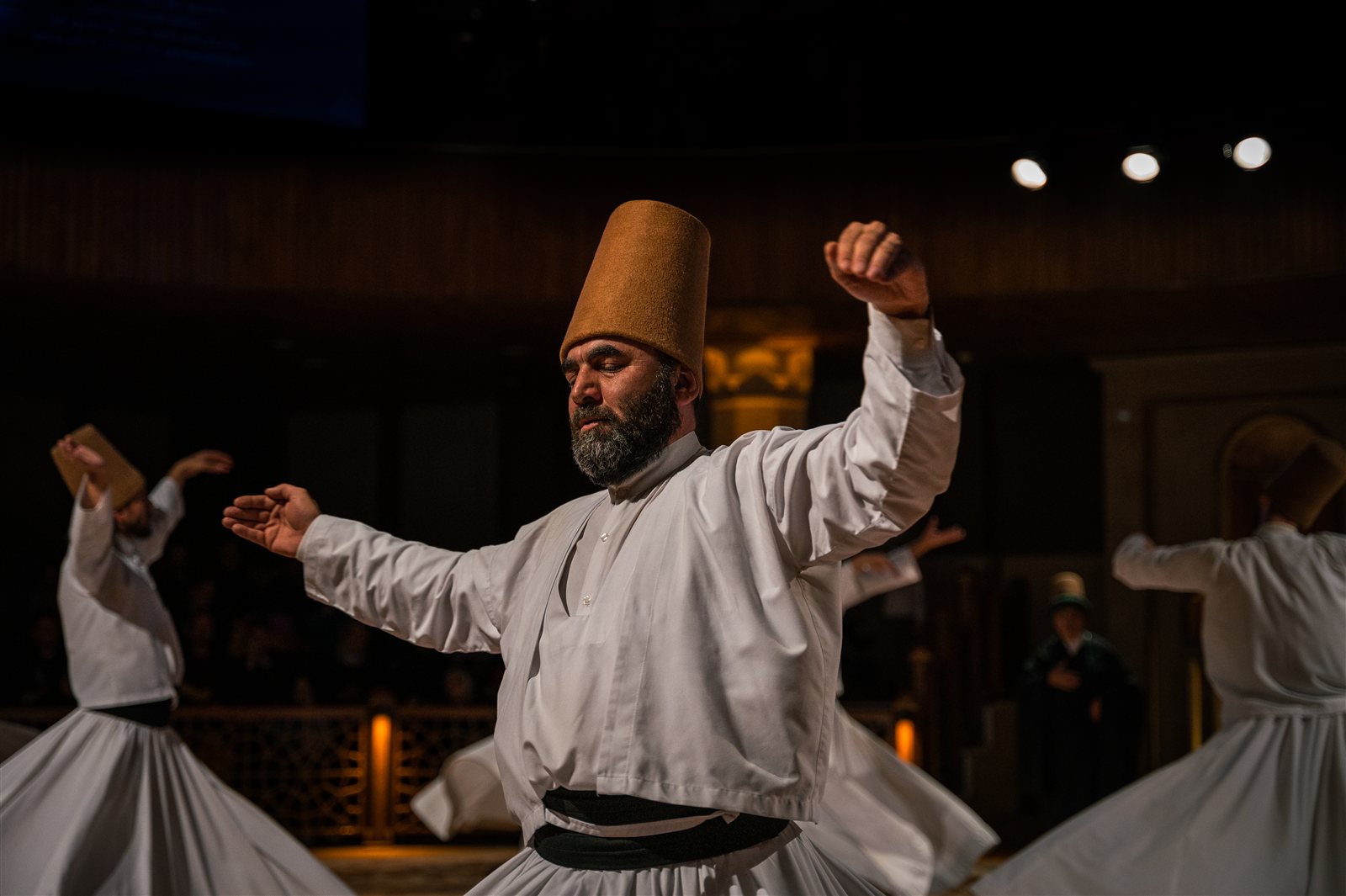
A man in a tall, honey-coloured felt hat and a long white skirt stands in a line of others, shoulder to shoulder, his arms crossed over his chest and each hand resting on the opposite shoulder. When his moment comes, he steps forward, bows to the sheikh and kisses the sheikh’s hand; the sheikh, in return, kisses the tall hat. Then he begins to turn. The left foot stays on the floor as a pivot, and the right foot steps around it once for every full rotation. After three turns the arms uncross, drop to the waist, and rise past the head before opening outward, the elbows kept softly open rather than bent. The right palm faces upward. The left palm faces downward. The eyes stay open but unfocused, so that the hall around him blurs. And with each rotation, in the account of one teaching organization within the tradition, the name of God is repeated inwardly, without a sound.
This is the Sema, the best-known ceremony of the Mevlevi order of Sufism, which was founded in Konya in the thirteenth century and is still practised today. The turners are called semazens. Those who practise it describe it not as a dance but as a prayer, a form of remembrance of God conducted with the whole body. In the tradition’s own teaching, the upturned right hand receives grace from above, and the downturned left lets that grace flow on through the semazen into the world below.
The turning is not where the ceremony begins, though. In the outline Mevlana.net gives, it is only the fifth of seven parts, and the preparation for it starts hours before anyone enters the hall.
Before the hall
UNESCO’s listing notes a recommended fast of several hours, and the Threshold Society, a Sufi teaching organization in the Mevlevi line, describes ritual washing and prayer before the garments go on. Each garment carries a meaning. Loose white trousers and a collarless shirt come first. Over them goes the tennure, a full white gown whose skirt is folded into eighteen pleats at the waist, with a weighted or quilted band at the hem that helps it bell outward once the turning starts; the Threshold Society likens it to a shroud. A long black cloak, the hırka, covers everything, and the tall felt hat, the sikke, stays on throughout. In the order’s reading, the hat is the tombstone of the ego and the cloak the covering of its grave. Beneath the cloak, the arms are crossed with the hands high on the shoulders, a posture the order reads as the Arabic letter alif, bearing witness to the oneness of God. It is in this posture, standing shoulder to shoulder in a line, that the semazens wait for the sheikh.
Breath, drum and a slap on the floor
The ceremony opens with a sung eulogy to the Prophet. Then comes an improvised solo on the ney, a reed flute, which Mevlana.net calls the Divine Breath, the first breath that gives life to everything. In the Threshold Society’s account, the first beats of the drum, the qudum, follow, and on the third beat the semazens and the sheikh slap the floor as they bow to the ground, then stand: called up, in its reading, out of non-existence into existence. Mevlana.net places the drum before the ney rather than after it, and hears in it God’s command to creation: “Be.” UNESCO’s listing gives the ensemble as at least one singer, a ney player, a kettledrummer and a cymbal player.
As new music begins, the sheikh leads the semazens around the hall with slow, stately steps, in a procession known as the Sultan Veled walk. It goes round three times, and each time the dervishes pass the sheikh’s place, they bow to one another in greeting. Mevlana.net counts this walk and greeting as the fourth part of the ceremony.
Permission to turn
Then the music shifts again, and the fifth part, the turning itself, begins. It unfolds in four stages called selams, each opened by a change in the music. At the start of the first, each semazen kisses his black cloak, holds it for a moment to his forehead, and lets it fall to the floor behind him. A second account from within the tradition describes the one who removes it as “spiritually born to the truth.” The sheikh recites a short prayer inwardly, without speaking it aloud, which the Threshold Society translates as an invitation to “turn in the circle of true existence,” in harmony with one’s own capacity and nature. Then the semazens come forward one at a time, bow, and kiss the sheikh’s hand, which the Threshold Society calls the moment of permission to begin the turn. This is the scene with which this article opened.
The Threshold Society’s instructions fill in the footwork. Each rotation begins with a half-turn made on the spot, both feet still in place; then the right foot steps around and down once, bringing the semazen back to face the sheikh. UNESCO’s listing describes the same pivot on the left foot, and asks for a body that stays supple. Once the arms have opened, they are held above the shoulders, the right hand slightly higher than the left, for as long as the turning lasts.
The name of God, repeated inwardly with every turn, ties all of this to a much wider Sufi practice. A scholarly study of the ceremony identifies the Sema as the Mevlevi order’s own form of zikr, a word meaning “remembrance”: the continuous chanting of the name of God, or of one of God’s ninety-nine names. Sema itself means listening, and as a Sufi ritual it is found across the Islamic world, in the form of listening to chanted or recited poetry, sometimes with instruments and sometimes without. What distinguishes the Mevlevis, the same study notes, is that they turn: the poetry is sung while the dervishes spin, each on his own axis. In one ceremony the author observed, in a concert hall, led by a sheikh whose training passed through a chain of teachers back to a historic Mevlevi lodge, the dervishes chanted the name of God inwardly as they turned.
Servant, awe, love and return
In the same study, each of the four selams is meant to carry the semazen through a different inner state. The first is meant to bring home to him his place as a servant of God. The second is meant to evoke awe at God’s greatness and power. The third is ecstatic love for God: the rhythm quickens, and the Threshold Society describes it as the moment of union, when the self’s separate existence falls away. The fourth brings the semazen back: to servanthood, in the scholarly study, and to his task in the world, in Mevlana.net’s account, which is explicit that the aim of the Sema is not unbroken ecstasy or the loss of conscious thought.
In this last selam the sheikh himself enters the circle and turns slowly at its centre. The turning ends when a recitation from the Qur’an begins; everyone stops, returns to their places and sits to listen. The verse usually recited, in the Threshold Society’s rendering, is about turning itself: “Wherever you turn, there is the Face of God.” A prayer of blessing closes the ceremony.
From Rumi’s son to a religious order
UNESCO’s listing dates the Mevlevi order to 1273, in Konya. The scholarly study credits its founding to Sultan Veled, son of the poet Jalal al-Din Rumi, in the late thirteenth century, with the aim of preserving his father’s teachings. Over its history the order established more than thirty-four dervish lodges, or tekkes, in which dervishes lived a monastic life with a sheikh to guide them. UNESCO’s listing puts the traditional training at 1,001 days, spent in seclusion inside a Mevlevi lodge. Prayer, religious music, poetry and dance were the means through which a dervish came to learn the order’s ethics, its rules of conduct and its beliefs. By the modern period the Sema was held weekly in these lodges, in a room built for the purpose, the semahane.
The sequence described above, from the crossed arms beneath the cloak to the four selams, can be seen in the recording below, filmed and distributed by the International Mevlana Foundation, an Istanbul-based organization founded in 1996 to research and carry forward Rumi’s work.
The ceremony itself did not arrive fully formed. Sufi sema reaches back to the ninth and tenth centuries, and the Mevlevi version was shaped by many contributions over a long period, beginning with Sultan Veled himself, who died in 1312, before it was finalized in the fifteenth century.
Closure and a fragile continuity
In 1925 the parliament of the newly founded Republic of Turkey passed a law closing the country’s tekkes, smaller lodges and tombs, and abolishing a range of titles. The state seized the lodges’ assets, sealed their doors and sent their residents away; Sufi titles were banned, and so were the religious practices particular to Sufi orders, their chanting included. UNESCO’s listing places the closure of every Mevlevi lodge within the secularization policies of the time. The government began allowing performances again in the 1950s, in public only, and eased the restrictions in the 1990s. In Konya, the scholarly study adds, permission came after much negotiation between Mevlevi dervishes and the regional government, and the ceremony returned not as a religious rite but as a “cultural and touristic event”: a reclassification that let it be performed in public while moving it, administratively, out of the category of religion.
UNESCO, which inscribed the ceremony on its Representative List of the Intangible Cultural Heritage of Humanity in 2008, is frank about what those decades cost. During the roughly thirty years the tradition survived out of public view, its listing says, teaching centred on the music and songs, the spiritual and religious side was passed on less, and performances lost part of their religious meaning as a result. Many ceremonies are now staged for tourist audiences rather than in their traditional setting, cut down and simplified for commercial reasons. The same listing also records movement the other way: some private groups are working to re-establish the ceremony’s “original spiritual and intimate character.”
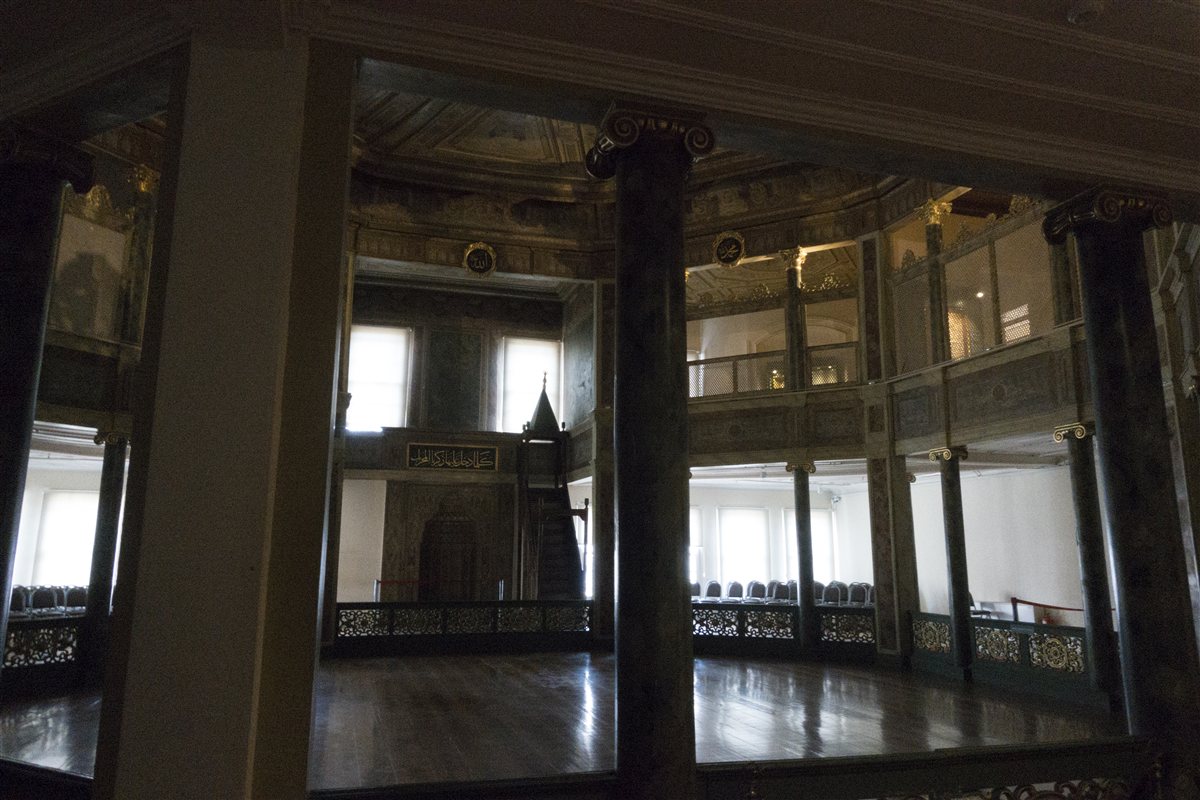
Today the ceremony is performed openly again. UNESCO names Konya and Istanbul as the order’s most active centres, and in the late 2010s, by the scholarly study’s account, two troupes employed by the government were performing it weekly in those two cities, in Istanbul at the Galata Mevlevi lodge, now a museum. For those who practise it, it remains a prayer conducted by turning: a body held upright and moving in a circle, one palm open to what it receives, the other to what it passes on.