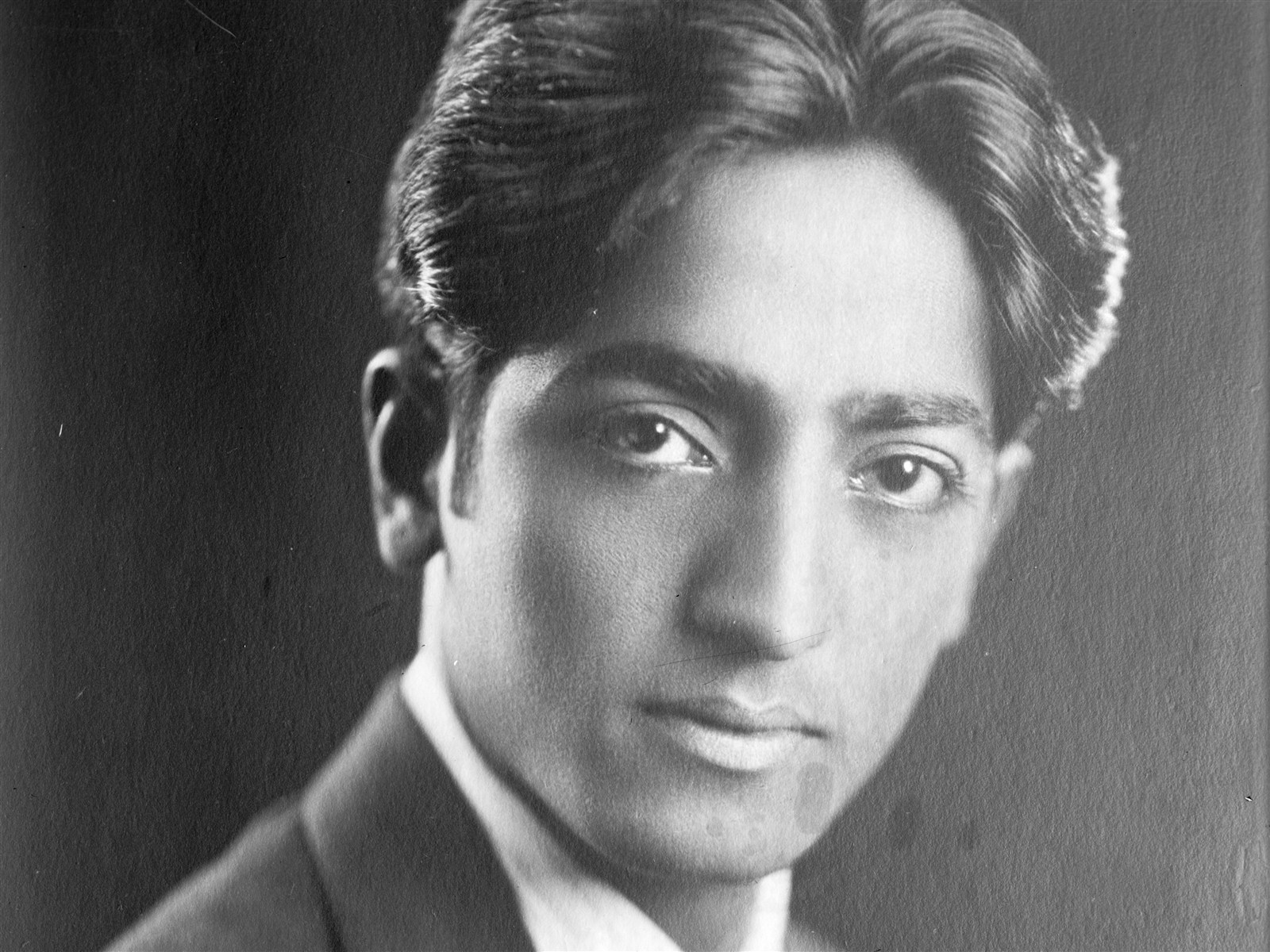
The encounter that decided Jiddu Krishnamurti’s life was, by his own account, unremarkable. In 1909, on the beach at Adyar on the southern edge of Madras, where the Theosophical Society had its international headquarters, a group of boys were paddling in the sea. An English Theosophist, Charles Webster Leadbeater, came down for his usual swim. Writing about it later, Krishnamurti remembered no particular conversation — “The meeting was quite casual,” he noted, and in any case, “I did not know English at all well.”
The boy had little else to recommend him. His father, a minor civil servant, had retired the year before on a pension too small to keep the family, had written to the Society asking for work, and had been taken on as an assistant secretary; they lived in a small house just outside the Adyar compound. Krishnamurti walked daily to the high school at Mylapore, where he was punished for inattention and where, by one biographer’s account, a teacher considered him half-demented. He was thin and poorly nourished. He was the eighth child of a Brahmin family of the Velanadu subcaste whose forebears came from the coastal Andhra country, born at Madanapalle in May 1895 — the eighth son, and given a name for Krishna, who in the stories is likewise an eighth child.
Leadbeater watched him for days, then told a young assistant helping him with his occult studies that one of the boys had a remarkable aura, an aura with no selfishness in it. The assistant knew the boys and was surprised: Krishnamurti was not one of the bright ones. Leadbeater was unmoved. This, he said, was the boy who would one day become a great spiritual teacher and speaker. Asked whether he would be as great as Annie Besant — the British social reformer who was the Society’s international president — Leadbeater is said to have replied: “Much greater.”
Besant had spent the previous year touring the United States, speaking constantly of the imminent coming of a World Teacher. She now proclaimed Krishnamurti that teacher: a messianic figure who, in the Society’s expectation, would bring about the enlightenment of the world.
Groomed for a role he did not choose
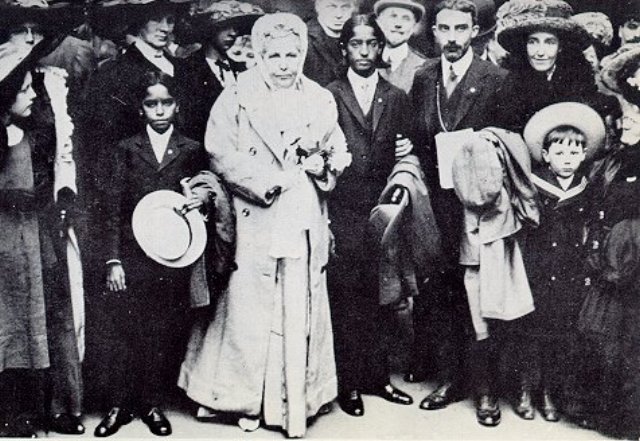
Besant prevailed on the boys’ father to hand over the guardianship of Krishnamurti and his younger brother Nityananda — Nitya, three years his junior — and their visits home soon ended. In 1911 the Theosophical Society founded an organization around the prophecy and around the boy: the Order of the Star in the East, established to proclaim the coming of the World Teacher, with Besant and Leadbeater named its Protectors and Krishnamurti, still in his teens, declared its Head. Representatives were appointed and offices opened country by country. The Order’s badge was a silver five-pointed star. A quarterly magazine, the Herald of the Star, was printed at Adyar with Krishnamurti as its editor, the first issue appearing in January 1911.
That same year Besant took both brothers to England, where they stayed with Theosophist friends and were moved from tutor to tutor — one of them George Arundale — in preparation for an English university. It did not work. Their names had been entered for Balliol College, Oxford, which refused Krishnamurti amid the controversy surrounding him; approaches to other Oxford and Cambridge colleges failed as well, and he could not pass the entrance examinations for London University, studying for days and then leaving the paper blank. Nor were the claims made for him uncontested at the time: Theosophists across India were in open revolt at Besant’s veneration of the boy, and an influential Madras daily attacked her relentlessly. She did not waver.
The break: “Truth is a pathless land”
On 3 August 1929, on the opening day of the Order’s annual camp at Ommen in the Netherlands, Krishnamurti stood before some 3,000 of its members — Besant among them — and dissolved the organization he headed. Members around the world, he told them, had been preparing for him for eighteen years and were still unwilling to listen to what he actually said.
What he said that day, in a speech the Krishnamurti Foundation Trust still publishes in full, he never afterwards revised. He maintained that “Truth is a pathless land”, approachable by no path, no religion and no sect, and that truth, being limitless, cannot be organized at all. Any organization created to lead people to it, he argued, “becomes a crutch, a weakness, a bondage” that cripples the individual it claims to serve. And he closed the door on discipleship in his own name: he had, he said, “no disciples, no apostles”, either on earth or in the realm of spirituality. The money and property donated for the work were returned. He was thirty-four, and would go on speaking publicly for most of the next six decades — but from that day as a man who had refused the one role he had been raised to fill.
What he actually taught
What Krishnamurti spent the rest of his life describing was not a method, a sequence of exercises, or a system to be practised and mastered — a point he insisted on as firmly as any other part of his teaching. It was, instead, a way of looking at one’s own mind, described across thousands of public talks and dialogues from the 1930s until his death.
The idea he returned to most often is usually rendered as “the observer is the observed.” Ordinary experience treats the person doing the noticing — the “I” who feels angry, or bored, or afraid — as separate from the anger, boredom or fear itself, something standing a little apart from it and judging or managing it. Krishnamurti held that this separation is itself a construction of thought, not a fact: the observer is made of the same memories, conditioning and past reactions as the thing it claims to be observing. When anger arises, in his account, there is no separate self watching the anger from a safe distance — there is only anger, and the sense of a separate watcher is the mind’s own habit of splitting itself in two. Seeing that split as false, rather than trying to fix or suppress what is observed, was for him the whole of the work.
The practical form this took he called choiceless awareness — attending to whatever is actually happening in one’s own mind, moment to moment, without selecting some parts to keep and others to reject, without comparing what is seen to some better version of it, and without the effort to change it. An ordinary act of attention usually has a direction built in: notice the anger in order to calm it, notice the fear in order to overcome it. Krishnamurti’s awareness had no such destination. It meant watching envy, or grief, or a passing irritation with someone at exactly the intensity it appears, neither pushed away nor indulged, on the reasoning that the wanting to change what one sees is itself a subtler form of the same conditioned reaction the observer is trying to escape.
He connected this closely to what he called psychological time — not the clock or the calendar, which he accepted as practically necessary, but the mind’s habit of living from a remembered past toward an imagined future: replaying an old hurt, rehearsing how to avoid its repetition, measuring the present against who one was yesterday or hopes to be tomorrow. In his account, most psychological suffering is sustained by this back-and-forth movement rather than by whatever is actually happening now, and the accumulated weight of memory and conditioning is what stands between a person and the thing directly in front of them. Choiceless awareness, held in the present without the tug of that remembered past, was the point at which he believed the movement of psychological time could stop, if only for a moment.
The tension in this he lived with for fifty-seven years. A man raised to be a spiritual authority went on addressing audiences for the rest of his life while insisting that no teacher, technique or organized path — including his own decades of talks — could carry anyone to the understanding he described. He refused to be treated as a guru, founded no religion, and prescribed no sequence of steps that, correctly followed, would produce the result. The talks, the dialogues and the books were offered, on his own account, not as instructions to adopt but as an invitation to look at one’s own mind directly — an invitation that, by his own logic, a reader is free to put down.
The books
Krishnamurti did not write his ideas up as a system. The books that carry them were compiled by others, mostly out of his talks and dialogues. Freedom from the Known (1969), edited by his biographer Mary Lutyens from a number of those talks, is the usual entry point: a compact run through the central themes, with chapters on learning about ourselves, the pursuit of pleasure, justification and condemnation, and the dissipation of energy. The First and Last Freedom (1954) has sold more copies than any of his other books. It sets out twenty-one themed chapters drawn from talks, followed by thirty-eight sections of questions and answers, on what we are seeking, what the self is, whether thinking can solve our problems, relationship, and the stillness of the mind. Its foreword was written by Aldous Huxley, who had become friends with Krishnamurti in the late 1930s, and who compressed the whole argument into one line: “Only choiceless awareness can lead to non-duality.”
Think on These Things (1964) was originally delivered as talks to students, teachers and parents, and has since sold more than three million copies in twenty-two languages. It is organized around plain questions — what is shyness, what is jealousy, what is happiness, what is sorrow — and around what Krishnamurti meant by real culture: not inheritance, learning, talent or genius, but a movement toward happiness and truth that decays wherever authority, tradition or fear blocks it. Commentaries on Living, published in three volumes between 1956 and 1960 at Huxley’s encouragement, is the most unusual of the four. It is built from encounters with ordinary people Krishnamurti met in India, Europe and America, each conversation set against the landscape in which it happened, working through ambition, fear, wisdom and what right action might be.
Schools and continuing influence
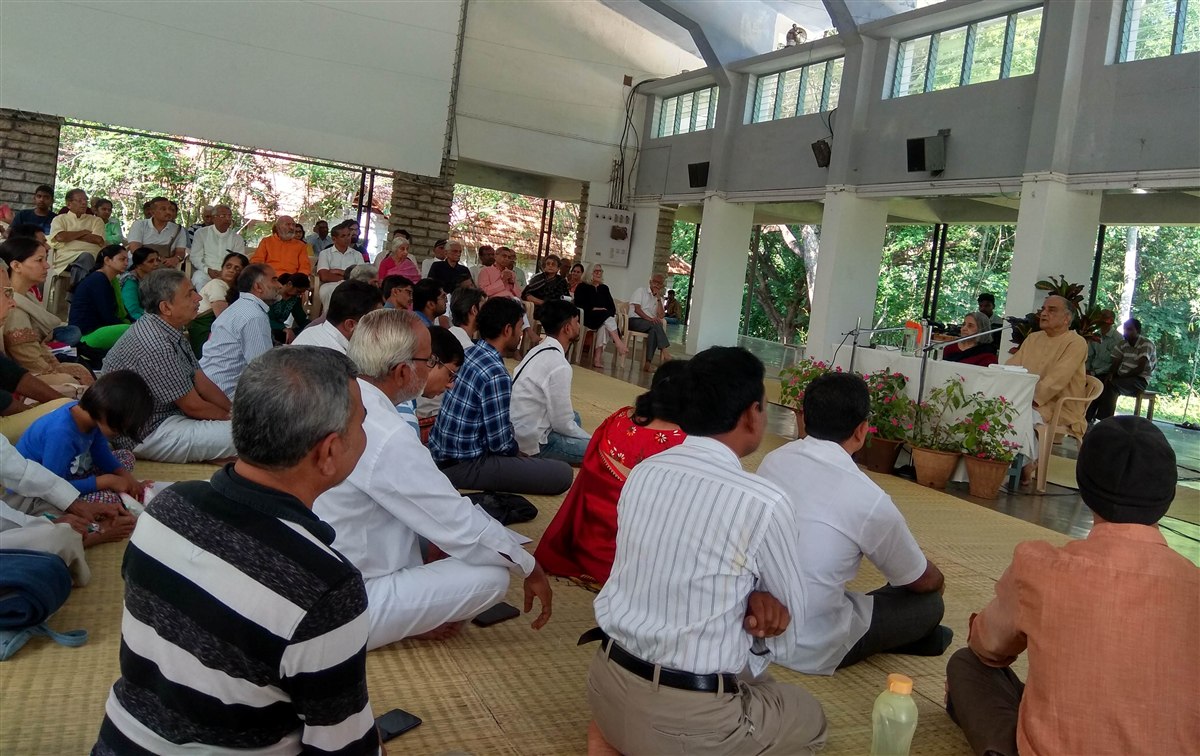
Krishnamurti founded or inspired a string of schools built around the idea that education should cultivate the same unforced self-observation his talks described, rather than train students toward examinations, careers or inherited belief alone. He left no blueprint for what such a school should be. Rishi Valley School was the first: in 1926 he chose a remote valley in what is now rural Andhra Pradesh, some fifteen kilometres from Madanapalle, the town he was born in. It is run today by the Krishnamurti Foundation India and is among the best-known residential schools in the country; he visited it nearly every winter until a few months before his death. Brockwood Park School, an international boarding school for fourteen- to nineteen-year-olds in the Hampshire countryside, followed in 1969, and the Krishnamurti Foundation Trust is still based on the same estate. Oak Grove School, in Ojai, California — the town he returned to for decades and where he eventually died — was founded in 1975 and belongs to the Krishnamurti Foundation of America; it began with three students and two teachers in an old ranch building.
He kept speaking for the rest of his life. The Second World War halted his travelling and he spent those years quietly in Ojai; afterwards he went wherever he was invited, and continued to do so until less than two months before his death, at Pine Cottage in Ojai on 17 February 1986, of pancreatic cancer, at ninety. His recorded output has been estimated at more than 100 million words. The talks and dialogues have been compiled into more than sixty books and translated into as many languages, maintained and distributed by the foundations he set up to keep the material available without an organization built around his own authority — in effect the same arrangement he had already dissolved once, in 1929.
One association outside his own following stands out. In 1959 the theoretical physicist David Bohm, then preoccupied with the meaning of quantum theory, read The First and Last Freedom. What caught him, by his own account, was Krishnamurti’s insight into the question of the observer and the observed — a question that had long sat close to the centre of his own scientific work. Bohm met him on one of his visits to London, began seeing him regularly, and the two went on to probe together the nature of space and time, and of the universal, in external nature and in the mind alike. Their recorded conversations were published as books, among them The Ending of Time (1985) and, decades after the conversations began, The Limits of Thought. Beyond that, and in keeping with his own account of what he was doing, Krishnamurti left behind no formal school of followers positioned to carry a “Krishnamurti method” forward in his name.
Many of his public talks and dialogues survive on film, some now widely viewed online. The clip below is drawn from that recorded archive and gives a direct sense of the manner described above: a public conversation conducted without notes, doctrine or a fixed answer supplied in advance.