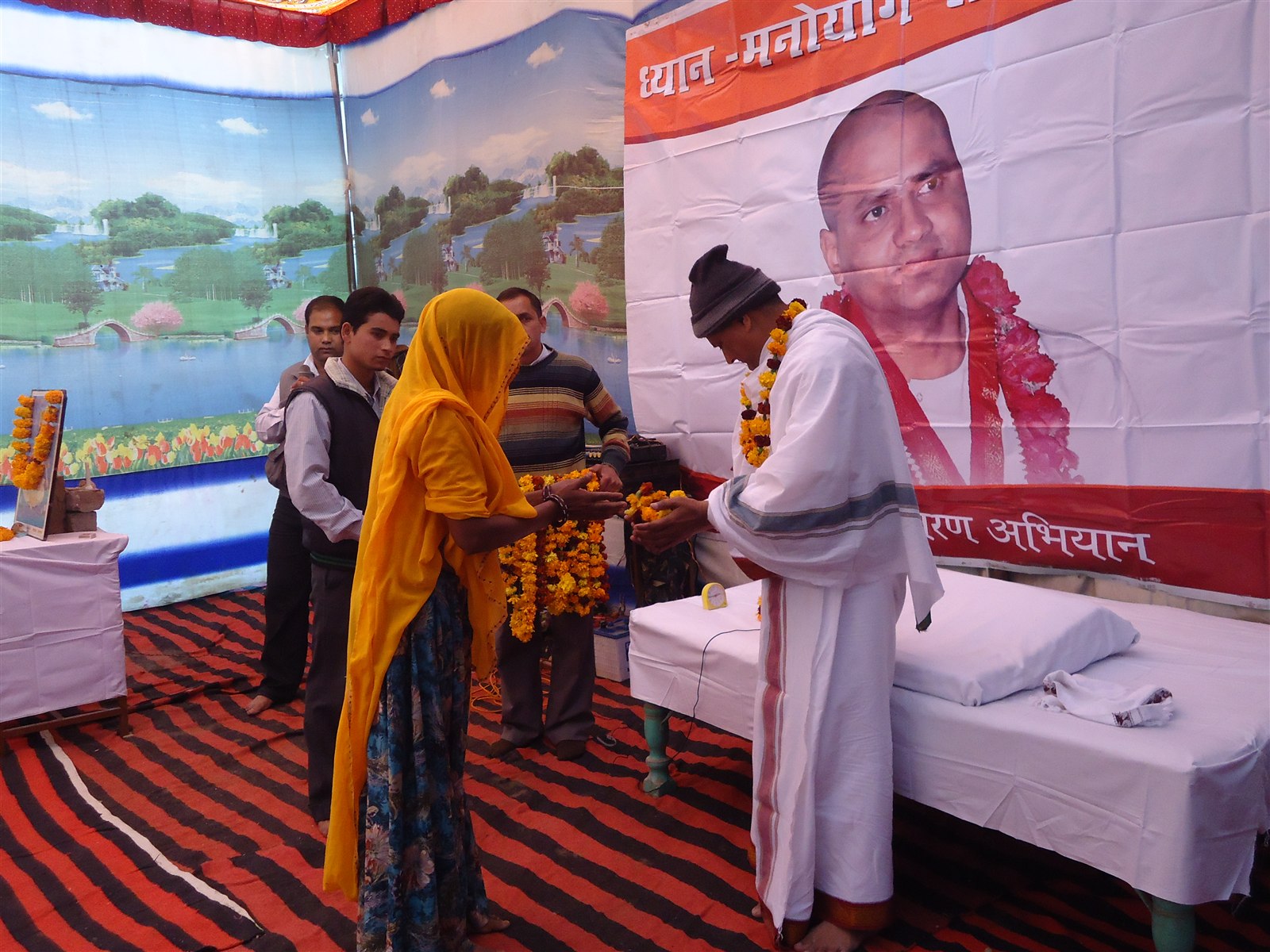
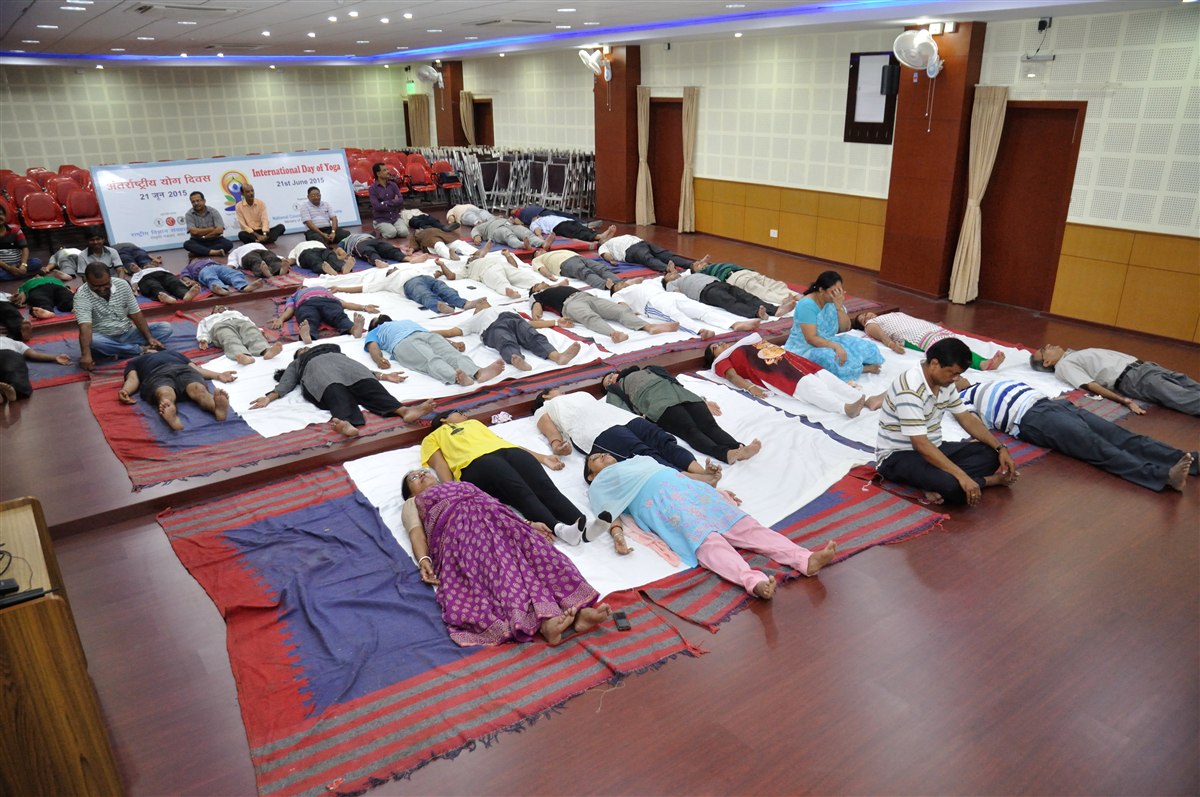
A person lies flat on their back, arms loose at their sides, palms turned upward. Nothing about the posture is unusual — it is shavasana, the “corpse pose” familiar from the end of almost any yoga class. What follows it is not. Over the next thirty minutes to an hour, without moving, the person will silently form a short personal resolve, then let their attention travel through dozens of named points across the body in a fixed order, count their own breath, deliberately summon sensations of heat and then cold, heaviness and then lightness, and hold an image in the dark field behind their closed eyes — all while a teacher’s voice, live or recorded, calls out each step in turn. The practice is yoga nidra, sometimes translated as “yogic sleep,” and its central claim is unusual among contemplative techniques: that a person can remain awake and aware while the body itself slips toward sleep.
The sequence itself
The structure that Pandi-Perumal and colleagues describe in a 2022 review is remarkably fixed for a practice with such old roots. The posture is set up with unusual care before anything mental begins: the practitioner lies supine with the arms and legs spread to roughly forty-five degrees, so that no limb touches another, and the palms turned upward. The point is to give the sense of touch as little to report as possible. Nothing is then to be moved for the rest of the session, and every instruction is to be heard.
It opens with the sankalpa — a short, clear, positive resolution, mentally repeated three times with complete determination. It may be something as large as self-transformation or as plain as the example the review offers: “I resolve to stop smoking.” Attention is then guided through a rotation of body parts, moving systematically down the right side, the left side, the back and the front, without the body itself moving at all. From there the sequence shifts to the breath: watching it, and counting it, often backward from a set number. A stage the review singles out as distinctive asks the practitioner to deliberately conjure paired opposite sensations — warmth and then cold, heaviness and then lightness, even pain and then pleasure — training the mind to produce a felt sensation on command rather than simply observing whatever arises. Visualization follows, directed at what texts call the chidakasha, the perceived dark space behind closed eyes, where images are held rather than analyzed. The session closes by repeating the sankalpa a final time, then reversing the whole movement: attention is turned back out toward external sounds and objects, the practitioner becomes aware of the body and the room again, each part is moved slowly and stretched, and only then, sitting up and unhurried, are the eyes opened.
Practitioners make a further claim, which the review reports as a claim rather than a finding — that an hour of yoga nidra is worth something like four hours of sleep — while insisting the practice is not a substitute for sleeping.
Where the pieces came from
None of these stages was invented for the modern practice. The review traces yoga nidra’s mechanics to two older strands within the broader yoga system. One is pratyahara, the control or withdrawal of the senses, in which mind and mental activity are disengaged from perceptual awareness — one of the eight limbs of the yoga system as the sage Patanjali codified it, and the discipline that gives yoga nidra its basic premise: attention can be turned inward and held there while the body rests. The other is nyasa, a tantric ritual technique in which mantras — sacred utterances, a sound, a syllable, a word or a set of words — are placed and felt at specific points of the body in turn. The name means, in the review’s rendering, to place, or to take the mind to that point: the direct ancestor of yoga nidra’s rotation of consciousness through named body parts. The review is equally clear that yoga nidra is not nyasa and not meditation, both of which are done sitting upright, with the spine straight and the practitioner awake and aware; yoga nidra is done lying down, and is classified instead as a sleep state in which awareness is preserved. For centuries these elements circulated separately, embedded in tantric ritual and yogic teaching passed from teacher to student rather than written down as a standalone method.
A repeatable method, and a name for it
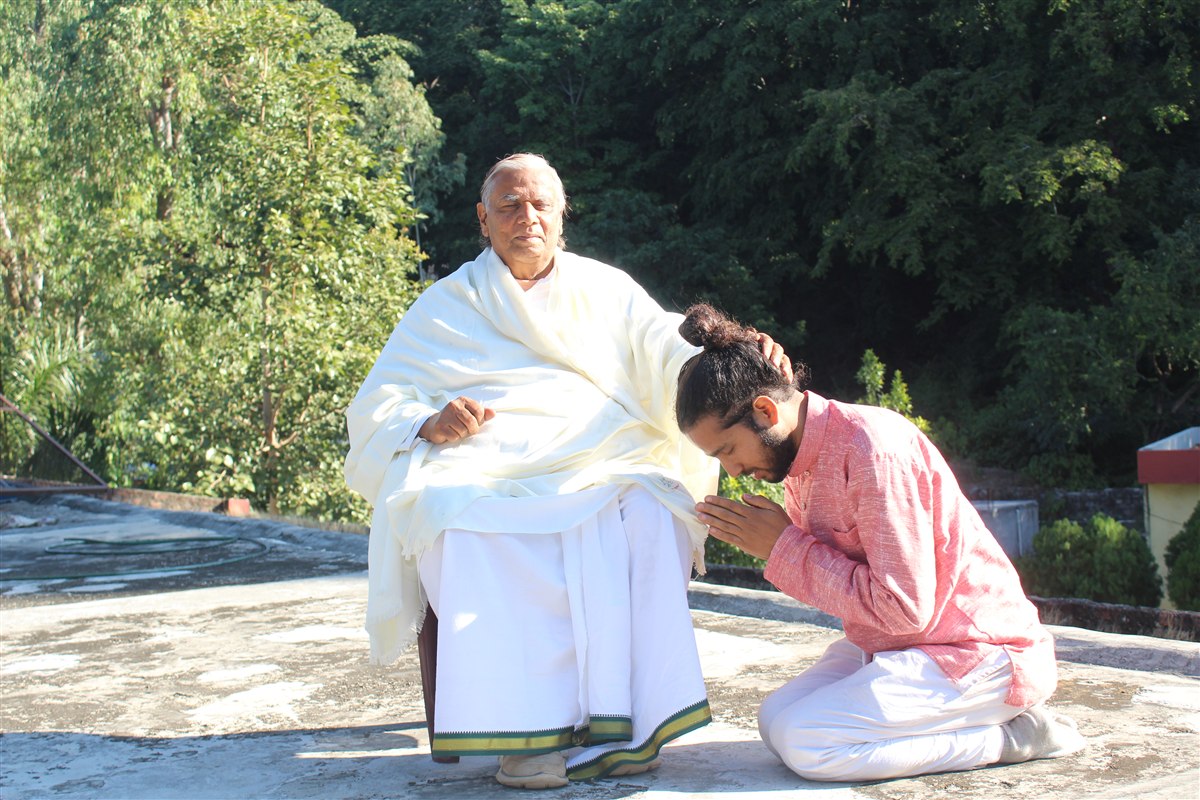
That changed in the mid-twentieth century. It was the writings of Swami Satyananda Saraswati, from the 1960s onward and published from Munger in the eastern Indian state of Bihar, that first brought an updated and systematized version of the practice to the public — the scattered elements drawn together into a single sequence that could be taught step by step and followed by a student who had never sat with a teacher at all. That is the repeatable shape the practice still has today — the shavasana posture, the sankalpa, the rotation, the opposites, the visualization, the return — turning what had been transmitted privately into something closer to an instruction set.
Not the same as the fourth state
Older texts are sometimes invoked to place what the practice is reaching toward. The Mandukya Upanishad sets out four levels of consciousness: waking, dreaming, dreamless deep sleep, and a fourth, turiya. The 2022 review notes that yoga nidra is sometimes identified with the third of those — the dreamless state in which the desire for any object of external experience has been lost, and which those in it are said to experience as bliss.
Turiya is the level above, and the review’s own glossary keeps the two firmly apart: turiya is where oneness is felt with the supreme spirit and the fundamental unity of the cosmos is experienced, and entering it depends on an inner silence that requires both the withdrawal of the senses and the overcoming of mental blocks. Practitioners hold that yoga nidra is closer to samadhi — the ultimate “deathless, breathless” state, in the review’s phrase — but differs in being far easier to achieve. The review’s own formulation is more modest than either: yoga nidra is better thought of as a valuable stepping stone on the path to samadhi than as an arrival at it.
Asleep in one respect, awake in another
That claim has a measurable counterpart. A 2022 study in Frontiers in Neurology took thirty volunteers through two weeks of practice, then wired them for polysomnography — the recording used to stage sleep in a laboratory — before, during and after a guided session. Scored against the standard sleep-staging criteria, the sessions came out as awake throughout. Yet delta activity, the slow-wave signature normally associated with deep sleep, rose in the central region of the scalp during the practice while falling at the front. The authors’ conclusion was neither sleep nor ordinary wakefulness: in novices, yoga nidra is electrophysiologically an awake state carrying signs of slow waves locally — what sleep researchers call local sleep.
Clinical work has mostly asked a narrower question: whether the practice helps people who struggle to sleep. A 2026 systematic review in the Journal of Integrative and Complementary Medicine pooled six randomized trials, 244 participants in all, and found most of them reporting better sleep onset, total sleep time or sleep efficiency — while judging the trials too varied in delivery and measurement to settle anything, and calling for more rigorous ones. A second 2026 review, working from a smaller pool, rated the evidence preliminary. The direction is consistent; the case is not yet made.
What the practice never does, on its own account, is cut a person off. The connection with the surroundings is not lost during yoga nidra — only the arousal those surroundings would normally produce is reduced, and with long practice the deeper layers of mental activity are said to become more reachable. That is the whole of what the sequence is built to deliver, and it is still delivered the same way: a body given every cue to fall asleep, and a voice naming the next body part, so that something stays awake to hear it.