In November 2025 the journal Communications Biology published something unusual in the literature on commercial meditation retreats: a minute-by-minute account of one. Seven days, beginning at five in the evening on the first day and ending at half past one on the seventh. Twenty-five hours of lectures. Thirty-three hours of guided meditation, all of it delivered over atmospheric music. Five hours of group healing rituals. One thousand four hundred and forty-four registered attendees, twenty of whom had their brains scanned and their blood drawn before and after the week.
The retreat was one of Joe Dispenza’s, and the paper carries Dispenza’s name among its authors. It is the closest thing on the public record to an independent, documented description of what happens inside his operation — and, in the same document, an unusually blunt account of who paid for the study and what its findings do not show.
What a participant actually does
The clearest third-party record of the practice comes from that 2025 paper, whose authors had to specify the intervention they were measuring.
Every meditation session at the retreat was guided rather than silent, and set to music. The paper classifies the sessions as Kundalini technique, and describes three things a participant is doing at once: holding a deliberate awareness of their own awareness; regulating the breath consciously; and moving attention slowly upward through a series of points along the body’s midline — the paper names the brow, the throat and the heart — which, it notes, practitioners regard as energetic centres. Guidance also asked participants to hold a state centred on the heart with thinking and judgment set aside, and to rest attention on a void outside the ordinary sense of space and time.
Dispenza’s own writing describes the same end-state in his own vocabulary. In a blog post published under his name on his teaching site, the seated or lying-down meditation is aimed at becoming “no body, no one, no thing, no where, in no time,” and it involves considering “who you no longer want to be” alongside who the practitioner is ready to become.
A second component carries that state into movement. Dispenza’s walking meditation begins standing still with the eyes closed, tuning attention to the heart and the breath; the practitioner then opens their eyes and walks while trying to hold the same internal condition, dividing attention between what the senses report from outside and what is going on inside. He describes the aim as learning to do with the eyes open what has been practised with them closed — “creating and sustaining mind and heart coherence.” The relationship between the two, in his framing, is that “Walking Meditations are more like the performance: the act of becoming,” with the seated sessions as rehearsal.
The third activity at the retreat was neither seated nor walking. Five hours went to group healing rituals in which six to eight participants, designated healers, gathered around one person designated the healee. The healers’ instruction was to practise loving-kindness compassion meditation — a practice in which, as a 2025 systematic review describes it, the meditator holds a particular person in mind while repeating phrases of goodwill such as “may you be peaceful” — while keeping attention on their own heart and hands and on the body of the person in the middle. The paper records that participants were given no mechanism for how the healing was supposed to work, and that the possibility of benefit to either party was framed the way an open-label placebo is framed in a trial. All twenty study subjects took part as healers.
From chiropractor to teacher of “elevated emotion”
Dispenza studied for a year and a half at Rutgers University before transferring to Evergreen State College, and took his chiropractic degree at Life University in Georgia, according to reporting by The Daily Beast.
The founding story of his teaching career is one he tells himself, and the distinction matters. By his own account, in 1986 he was in a serious cycling accident that left him with six compressed vertebrae; doctors told him he might never walk again and recommended spinal surgery. He says he checked himself out of hospital instead and set about reconstructing his vertebrae with his mind. Within ten weeks, he says, he was walking; within twelve, back at the gym. No medical or court record corroborating this account has been published, and it should be read as his recollection rather than a documented case history.
The Daily Beast also reports that Dispenza became an appointed teacher at Ramtha’s School of Enlightenment in Yelm, Washington — an organisation built around a woman who says she channels a 35,000-year-old spirit — from around 2001, and that he appeared in the 2004 documentary What the Bleep Do We Know!?, a film that attracted substantial scientific criticism for its use of quantum mechanics. He is widely styled Dr Joe; the same reporting notes that the online-only Quantum University lists him with a PhD, and that it found no evidence of an earned doctorate.
The scale today
Dispenza runs his teaching operation through a company, Encephalon, Inc. As listed on his own site in September 2026, six retreats were scheduled — in Switzerland, Denmark, Mexico and three locations in the United States — ranging in length from a three-day event to a week. The Daily Beast reports that retreats cost $2,299, that they sell out within days, that thousands attend individual events, and that Dispenza has some 2.5 million social media followers. The single retreat studied by the UC San Diego team had 1,444 registered attendees.
Measurement is built into the operation. His own research pages describe quantitative EEG and heart-rate-variability readings being taken from subsets of workshop attendees before and after sessions, carried out by his own team rather than an outside laboratory. The Daily Beast reports his claim to have collected more than 18,000 brain scans and 10,000 heart-rate measurements from participants; that figure does not appear on the research pages of his own site.
Twice, that in-house data collection has produced a peer-reviewed paper with outside academic partners. In 2020, a team led by the Bond University psychologist Peta Stapleton, with Dispenza as second author, published in IBRO Reports on EEG changes across 223 novice meditators during a three-day workshop, producing 5,616 EEG scans in total. The paper reports increases in theta, alpha, beta and gamma power and a small decrease in delta from before to the end of meditation, and states its conclusion carefully: the findings offer preliminary support for brief meditation altering states of consciousness in novices. Its conflicts-of-interest statement says that Dispenza may be remunerated for the meditation training examined in the paper, and that he was not involved in the analysis, to avoid bias; the study’s five other authors declared none. It received no specific grant funding.
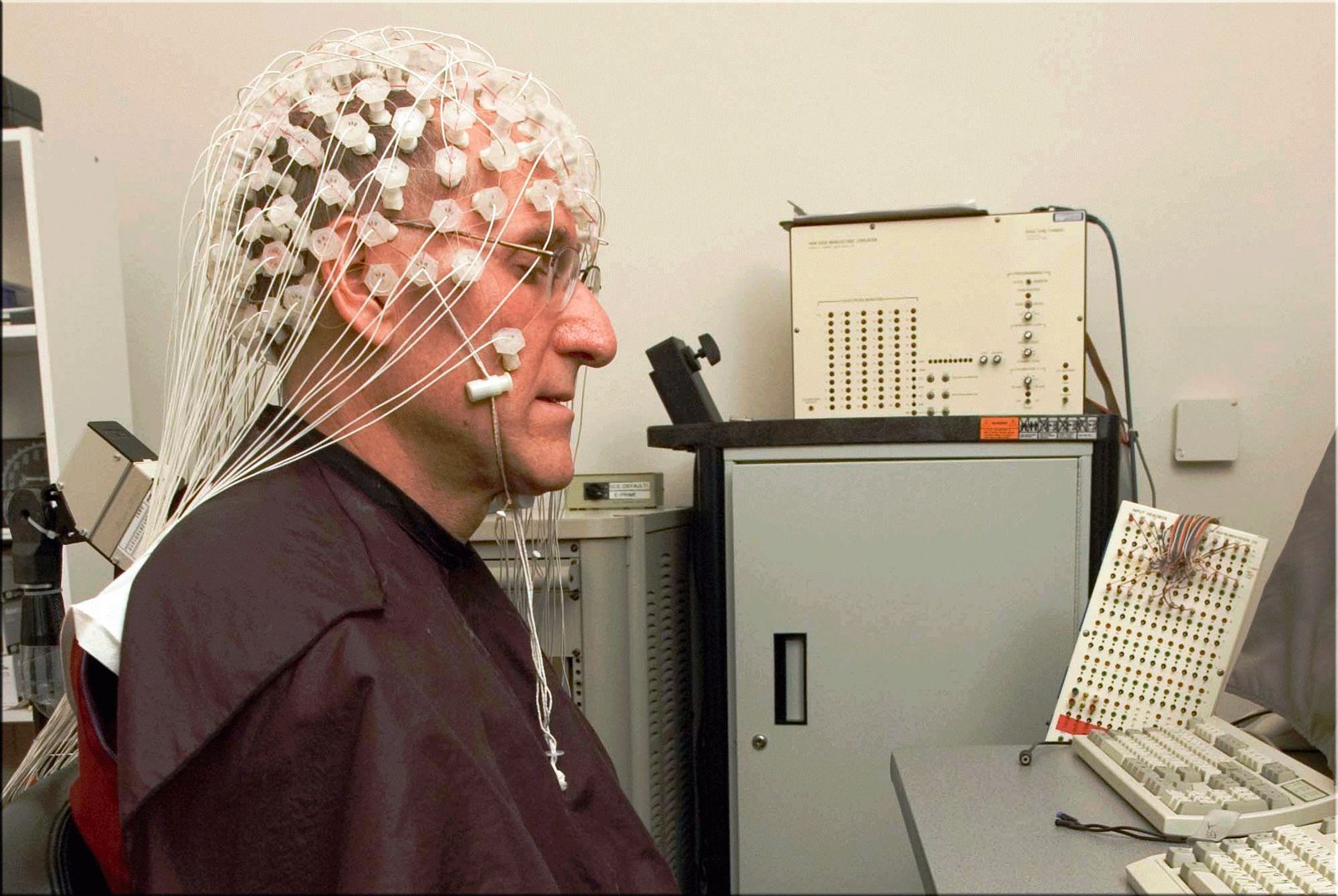
The 2025 study is the larger of the two. Alex Jinich-Diamant, a UC San Diego doctoral student, is its first author; the anaesthesiology professor Hemal H. Patel is its senior author, with co-authors at UC San Diego and at Metamorphosis LLC, VitaMed Research and the Institute for Advanced Consciousness Studies. Twenty healthy participants — eleven of whom had practised the retreat’s techniques for at least six months, nine of whom had not — were randomly selected from the 561 attendees who answered an eligibility questionnaire. They were given fMRI scans at rest and during meditation before and after the week, along with extensive blood work.
The reported results are specific. During meditation, connectivity within the default mode and salience networks fell, as did whole-brain modularity. Comparing blood plasma before and after the week, the authors report evidence of enhanced neuroplasticity and glycolytic metabolism and activation of endogenous opioid and neuromodulatory pathways. Scores on a mystical experience questionnaire rose from a median of 2.37 to 3.02.
The disclosures are equally specific, and stronger than the university’s news release conveys. The paper’s competing-interests statement records that Dispenza is the chief executive of Encephalon, Inc. and holds a financial stake in it — the company that sells the retreat under study. Patel discloses that the InnerScience Research Fund, which funded the research, is an independent 501(c)(3) non-profit with an executive board and a scientific advisory board that funds work both inside and outside Dispenza’s orbit. Additional support came from a Veterans Administration Research Career Scientist Award. The authors’ own first stated limitation is that the uncontrolled observational design limits their ability to infer causality, or to separate the contributions of meditation, placebo, reconceptualisation, expectation, diet, relaxation and simple distance from ordinary stress. They add that the small sample and its partial reliance on experienced meditators limit how far the findings generalise. UC San Diego’s news release put the same point in the university’s own words: controlled trials in patient populations are still needed before clinical benefits can be determined.
What independent scrutiny has found
Outside Dispenza’s own operation, the assessment has been considerably harsher.
The Daily Beast counted forty taped testimonials on his website from attendees describing recoveries from conditions including cancer, multiple sclerosis and infertility, presented alongside the claim that his organisation has “observed hundreds of healings from a wide variety of health conditions.” Nicholas Van Dam, a meditation researcher at the University of Melbourne, told the publication why such accounts cannot settle anything: “There’s no verifying what actually caused the outcome.” He went on to say that this unresolvability is exactly where the persuasive force of a testimonial comes from. On Dispenza’s use of research language more broadly, Van Dam’s assessment was that “It sounds like it’s science, it sounds like scientific evidence, but it’s not.”
The physics vocabulary draws a separate line of criticism. In an interview cited by the same reporting, Dispenza claimed that meditating in the presence of others — combining what he called coherent fields — opens “interference patterns of fractal geometry that are doors to dimensions.” Peter Woit, a theoretical physicist at Columbia University, called that “almost spectacularly complete nonsense.” Nothing in either of the peer-reviewed papers bearing Dispenza’s name measures anything at the quantum scale; the instruments involved are EEG caps, MRI scanners and blood assays.
Dispenza declined a detailed request for comment for that reporting.
What the record actually shows
Judged by what can be independently verified, Dispenza’s most concrete achievement is institutional rather than medical. He has built a teaching and data-collection operation large enough that a single one of its retreats can supply a research cohort, and specific enough in its methods that outside academics — at Bond University in 2020, at UC San Diego in 2025 — judged the resulting questions worth testing and published the answers in peer-reviewed journals. That is a genuine, if narrow, accomplishment for a practice built and sold largely outside mainstream medicine.
What has not been established is the claim that gives the practice its popular pull: that the sequence of breath, attention and what Dispenza calls elevated emotion causes the recoveries described in his own testimonials. Neither published study was designed to test that. The 2020 paper measured brainwave power in novices over three days. The 2025 paper measured brain connectivity and blood chemistry in twenty healthy volunteers over seven days, with no control group, and its authors say plainly that the design cannot establish cause. Both papers include Dispenza as an author, and in the second he is chief executive of, and financially invested in, the company selling the intervention.
A week of intensive practice measurably changes brain activity and blood chemistry in healthy people. That much is now on the record. Everything claimed beyond it remains Dispenza’s own claim.