
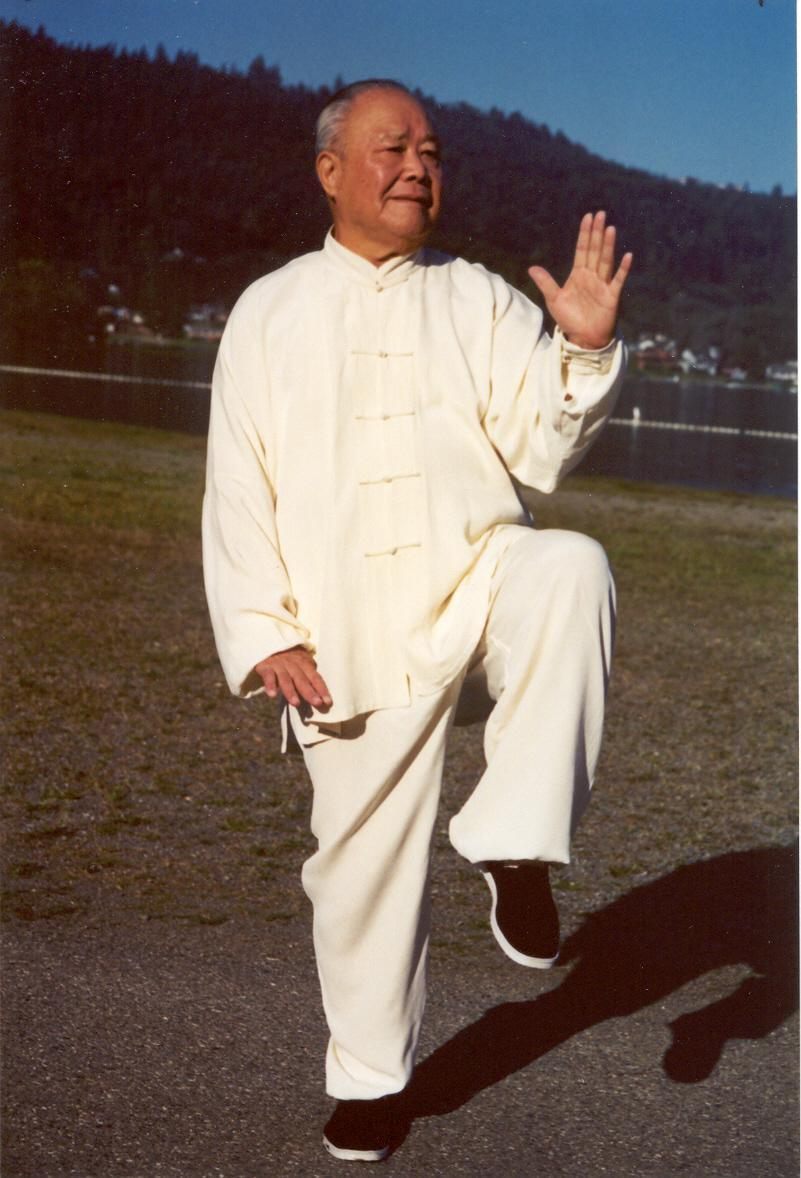
Three times a week for six months, between 2001 and 2002, physically inactive adults aged 70 and over — recruited through a Portland, Oregon health system — worked through the classical Yang style in its twenty-four-form version, the abbreviated set the Chinese government sponsored in 1956. Each hour-long class ran to music and opened and closed with five to ten minutes of warm-up and cool-down. On the other side of the country, in the years before its 1996 publication, a Tai Chi program had been taught to older adults in Atlanta as one arm of a federally funded research project with an unglamorous acronym: FICSIT, for Frailty and Injuries: Cooperative Studies of Intervention Techniques. Both groups were being tracked for a single outcome that has nothing to do with flexibility, philosophy, or stress: whether they fell down.
What a participant actually does
The Portland trial, published in 2005 by a team led by Fuzhong Li of the Oregon Research Institute, is unusually specific about the technique it tested. Participants followed “the classical Yang style (24 forms),” instructed by experienced teachers in classes that emphasized, in the authors’ own words, “multidirectional weight shifting, awareness of body alignment,” and coordinated movement of the arms, legs and trunk together. Breathing was not incidental to the exercise — the paper describes it as “synchronized” and “aligned with each Tai Chi movement,” woven into the sequence rather than treated as a separate instruction.
In practice, this means a participant is continuously transferring body weight from one leg to the other while turning the trunk and moving the arms through slow, circular paths — bending the knees, rotating at the waist, and shifting the center of gravity toward the edge of a stable stance before shifting it back, all at a pace slow enough that each transition can be corrected mid-movement rather than reacted to after the fact. The Atlanta trial, published in 1996 by a team led by Steven L. Wolf of Emory University’s Department of Rehabilitation Medicine, tested what its authors described as a “moderate” Tai Chi intervention over fifteen weeks. Its published report does not itemize which movements that curriculum contained.
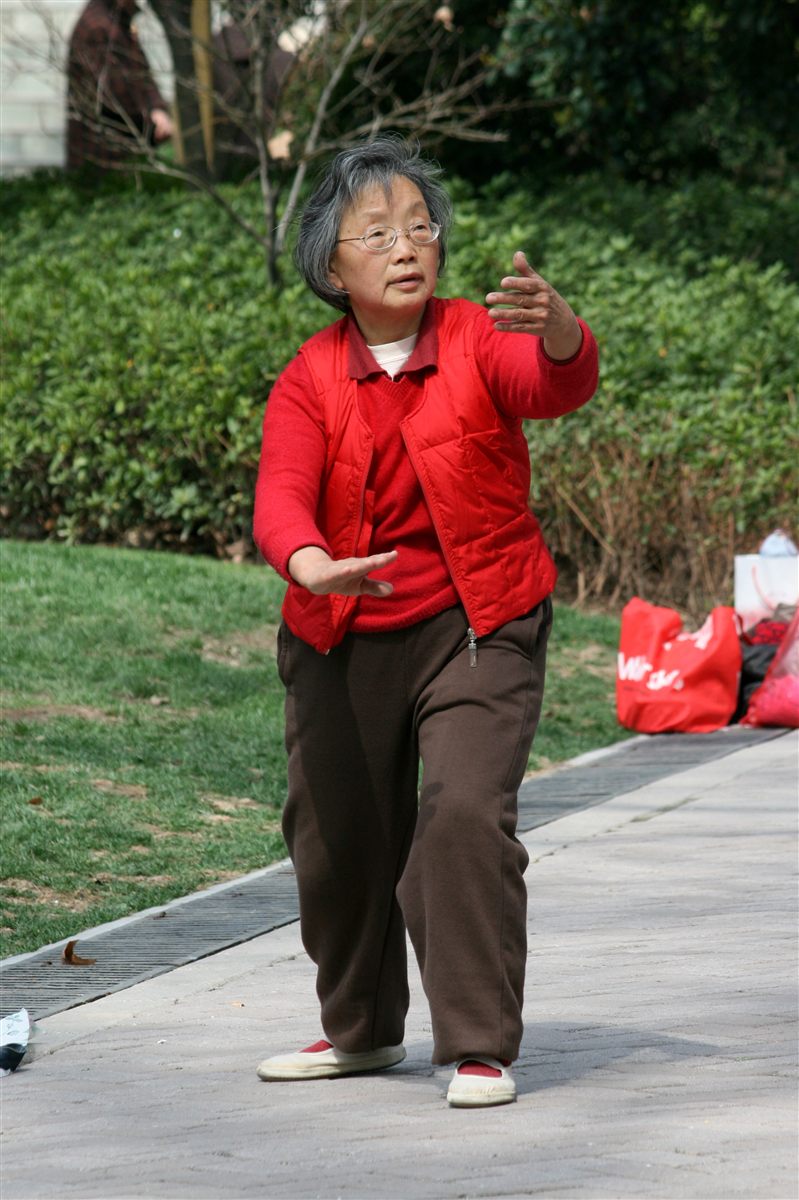
A later program — Tai Ji Quan: Moving for Better Balance, developed by Li himself and described in a 2014 paper in the Journal of Sport and Health Science, and so an extension of his own work rather than independent confirmation of it — spells out the same mechanics in more granular form: “bilateral weight-shifting initiated from the waist,” movement “synchronized” with “deep abdominal breathing,” and movement of the center of gravity across the base of support, incorporating unilateral weight-bearing, trunk rotation, ankle sways, and “coordinated eye-head movements.” Its eight forms run in order from Move a Ball through Part Wild Horse’s Mane, Single Whip, Wave Hands like Clouds, Repulse Monkey, Brush Knees and Fair Lady Works at Shuttle to Grasp Peacock’s Tail — the seven after the first taken, in the paper’s words, from the 24-form set “in a sequence ranging from simple to complex.” None of this is presented as a spiritual or martial practice in the trial literature; it is described, and was studied, purely as a form of postural-control training that happens to move the body continuously rather than holding it still.
The Atlanta trial: a 47.5 percent reduction
The Atlanta FICSIT trial randomized 200 community-dwelling adults aged 70 and older — 162 women and 38 men, mean age 76.2 — into three arms: the Tai Chi program, a computerized balance-training program, or a health-education control group. The intervention ran 15 weeks, with primary outcomes measured before and after it and again at four months, and falls monitored continuously throughout. After adjusting for fall risk factors, the investigators reported that Tai Chi reduced the risk of multiple falls by 47.5 percent. Participants who did Tai Chi also reported reduced fear of falling relative to the education group (P = .046), and showed lowered blood pressure both before and after a 12-minute walk. The authors’ own conclusion was measured rather than triumphant: a “moderate” Tai Chi intervention could favorably affect biomedical and psychosocial indices of frailty and could also have favorable effects on the occurrence of falls, and Tai Chi “warrants further study” as an exercise treatment to improve the health of older people — not, at that stage, a settled recommendation.
Portland: a larger trial, a sharper number
The 2005 Oregon trial had an explicit prompt. A joint statement on fall prevention from the American Geriatrics Society, the British Geriatrics Society and the American Academy of Orthopedic Surgeons had called Tai Chi a promising type of exercise that nonetheless “requires further evaluation” before it could be recommended as the preferred balance training; Li’s team wrote that they ran their trial to act on that recommendation. It randomized 256 physically inactive adults aged 70 to 92 to either the 24-form Tai Chi class or a stretching control group of seated and standing stretches with deep abdominal breathing and relaxation — deliberately built to match Tai Chi’s social interaction and enjoyment without supplying its lower-extremity strength and balance training. Over six months, the Tai Chi group recorded 38 falls against 73 in the control group — a difference the authors report as statistically significant (p=.007) — with a lower proportion of participants falling at all (28 percent versus 46 percent) and fewer injurious falls (7 percent versus 18 percent). After adjusting for baseline differences between groups, the risk of multiple falls was 55 percent lower in the Tai Chi group, with a 95 percent confidence interval running from a 30 percent to a 70 percent reduction. Functional balance measures — including the Berg Balance Scale, a test of gait adaptability called the Dynamic Gait Index, and single-leg standing time — all improved significantly more in the Tai Chi group, and those gains were still measurable six months after the classes ended.
The authors’ account of when the benefit arrived is notable. Some reduction in falls did appear in the Tai Chi group after the first month, but the most evident reduction began only after the first three months of training — which led them to write that “no tangible results in falls should be expected from short-term exposure to Tai Chi,” a span they defined as under three months. They also proposed a mechanism, hedged in their own words as tentative: that Tai Chi’s emphasis on “control over one’s displacement of body mass, postural alignment, and range of motion” of the lower body may be part of a larger process producing gains in leg strength and postural stability, which possibly prevents older adults from losing their balance. The underlying mechanism, they added, “remains largely unknown,” and they called for systematic study of the movement’s kinematics, kinetics and neuromuscular activity.
The paper’s own conclusion is correspondingly confident: older people can decrease the number of falls and injurious falls through a regular program of Tai Chi, and, the authors argued, the accumulated evidence meant the time was near for it to be recommended as a preferred exercise for balance training.
When it didn’t hold up: a frailer population
Wolf returned to the question in a second, larger trial published in 2003 — led again from Emory, though with an otherwise entirely different set of co-authors — this time in a frailer population: 291 women and 20 men in twenty congregate living facilities in the greater Atlanta area, aged 70 to 97, meeting criteria for “transitioning to frailty.” The protocol was more intensive — 48 weeks rather than 15 — and was compared against a wellness-education program. The primary result did not replicate the earlier finding: 47.6 percent of the Tai Chi group fell at least once over the 48 weeks, against 60.3 percent of the education group, a risk ratio of 0.75 that was not statistically distinguishable from no effect (95% CI 0.52 to 1.08, P = .13).
The paper’s own conclusion resisted overstatement in either direction. Tai Chi “did not reduce the RR of falling in transitionally frail, older adults,” the authors wrote — but they argued that the direction of the effect they had observed, taken together with the positive findings seen previously in more robust older adults, suggested Tai Chi might still be clinically important in this high-risk group and should be evaluated further there. Li’s team, reviewing the same trial two years later, read it more warmly still, describing it as showing a significant reduction in the risk of multiple falls among transitionally frail adults once a three-month latency period of learning Tai Chi had passed.
What the broader evidence shows
A Cochrane systematic review led by Catherine Sherrington — published in full in 2019 and condensed into an abridged version in the British Journal of Sports Medicine the following year, the fuller document being the one that carries the figures below — pooled 108 randomized controlled trials and 23,407 participants testing exercise interventions against falls in community-dwelling older adults. Exercise overall reduced the rate of falls by 23 percent, rated high-certainty evidence. Balance and functional exercises specifically reduced falls by 24 percent, also high-certainty. Tai Chi’s results split across the review’s two fall outcomes, and the split matters. On the rate of falls — the review’s primary outcome — Tai Chi “may reduce” falls by 19 percent, drawn from seven trials and 2,655 participants, and the review graded that finding low-certainty evidence, a weaker grade than the high-certainty one given to balance and functional exercise. But on the second outcome, the number of people who experience falls, Tai Chi reduced the figure by 20 percent across eight trials and 2,677 participants, and that finding the review graded high-certainty — a larger effect on that measure than balance and functional exercise’s own high-certainty 13 percent. The review’s summary line for Tai Chi is neither an endorsement nor a dismissal: Tai Chi “may also prevent falls,” it says, while the effects of resistance training alone, dance and walking remain uncertain.
Whatever drove the low grade on the rate-of-falls estimate, the review notes a limitation running through the literature as a whole rather than through Tai Chi in particular: most of its 108 trials carried an unclear or high risk of bias on one or more items, mainly, the review’s summary states, reflecting a lack of blinding of participants and personnel to the interventions — a near-inevitability when the intervention is an exercise class. Li’s own 2005 paper makes the same point about itself directly: five of its thirteen research assessors were aware of some participants’ group assignment during functional assessment sessions, a limitation the authors disclosed themselves rather than one uncovered afterward, though they noted that none of the research assistants knew any participant’s previous scores and that most of the tests used objective criteria.
Reading the trials together
Taken as a set, the evidence does not point in one direction uniformly. Two trials — one published from Atlanta in 1996, one from Portland in 2005, with no authors in common — found substantial reductions in falls among community-dwelling older adults following several months of a slow, weight-shifting Tai Chi practice. A third, led again by Wolf and using a longer, more intensive protocol in a frailer population living in congregate care, found the proportion of people falling lower in the Tai Chi group but not by a statistically significant margin, and said so plainly while arguing the question was still open. The Cochrane review’s pooled estimates sit below the individual trials’ headline numbers and carry different certainty grades depending on which fall outcome is measured.
On the question of how long the practice takes to work, only one of the four sources speaks directly. The Portland investigators traced their most evident reduction to the period after the first three months of training and warned against expecting tangible results from shorter exposure — a finding from a single trial, not a pattern established across the literature. The Atlanta trials ran fifteen and forty-eight weeks respectively; neither they nor the Cochrane review reports a comparable month-by-month account of when the benefit appears.